
It’s September, which means that if you’re leading customer success in a European B2B SaaS scale-up or small enterprise, you’re probably already looking at next year’s retention and expansion number.
How much growth needs to come from customers you already have?
And how confident are you, really, that those customers will renew, expand, and keep choosing you when an AI-native competitor turns up with something faster, simpler, and apparently “good enough”?
This matters particularly for B2B SaaS scale-ups with relatively simple solutions, where switching can be easier and new competitors can enter an account quickly.
When the practical barrier to switching is low, the strength of the customer relationship and the value your team can demonstrate become much more important.
Your biggest competitive risk may not be that they have a better product. It may be that they start a better conversation.
They arrive with no history and nothing to defend. So they ask questions.
What are you trying to achieve? What’s getting in the way?
What is that costing you today? Who else is affected? What would a better outcome look like?
Meanwhile, your team has been in the account for three years, and the conversation has quietly become:
“How’s adoption?” “Any support issues?” “Want to see what’s new?”
In too many accounts, the meaningful conversation only really starts when the renewal date gets close and by then, it is too late.
The relationship may not be particularly strong. The value may never have been made visible.
And very often, there is little or no relationship with the executive who will ultimately decide whether the contract grows, stays where it is, or becomes a replacement target.
That executive is not thinking about your features.
They are thinking about revenue, cost, risk, productivity, growth, and whatever else they are accountable for.
So the useful question isn’t “how do we make Account Managers and CSMs better at relationships.” It’s “how do we help them connect what’s happening on the ground to what an executive actually cares about.”
That is a trainable skill.
when a Customer Success team develops it, the account conversation changes.
They know whether value is being realised long before renewal. They uncover expansion opportunities naturally instead of searching for them at quarter-end. They connect operational issues to executive priorities.
And when a competitor enters the account, the customer has a much clearer reason to stay.
That starts with what they learn to find inside the account itself.
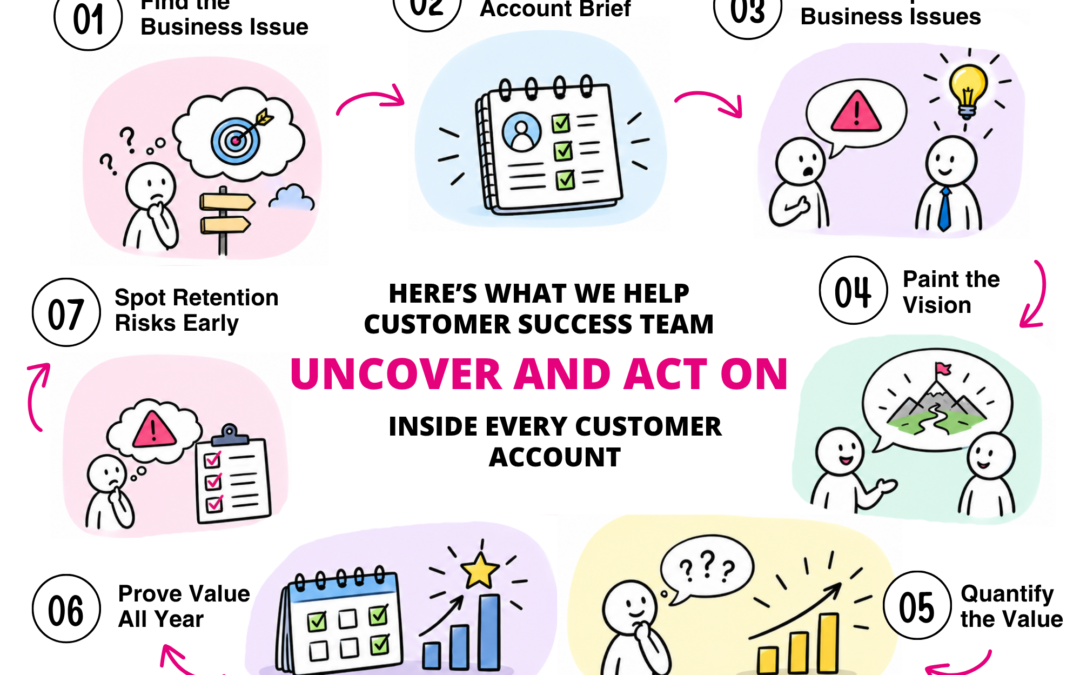
Here’s what we help your customer success team uncover, and act on, inside every customer account:
1. The business issue that makes the customer want to act.
A feature request isn’t an expansion opportunity yet. A frustrated user isn’t a business case yet. We train your team to ask what the customer’s trying to achieve, what’s blocking it, and why it matters right now, before assuming there’s a reason to act.
2. A running account brief that tells you why this account renews and where it grows.
We help your team build the habit of capturing the person, their real business issue, what they need, the value they’re expecting, and their deadline, all in one place, not spread across CRM notes and memory, so your team, or anyone stepping into the account, always has the full context instantly
3. A complaint turned into a reason an executive cares.
When a customer says “this report takes forever,” most teams move on. We train yours not to. Ask why that’s a problem, what happens because of it, who else is affected, and what’s now at risk. Four questions turn one user’s complaint into a business issue worth a VP’s attention, and a legitimate reason for your team to be in that room.
4. A vision of what better looks like, shaped by the customer.
We coach your team to show a short, relevant scenario, then ask “how does this compare with your situation,” and stop talking. What the customer says next gives you their version of what better looks like, and that’s often where the next expansion opportunity starts.
5. The number the customer says out loud.
“Too many people are involved” isn’t a number. We train your team to push for how many today, and what it should be. The gap between those two numbers is what makes the value real, because the customer said it, not because it’s on a slide.
6. Proof of value shown all year, not assembled three weeks before renewal.
We help your team build the discipline of surfacing wins as they happen, a process that used to take three days now takes four hours, one visible result after another, so by renewal the evidence already exists instead of needing to be built in a single call.
7. The early warning signs an account is quietly becoming a retention risk
A customer can enjoy the demo, say nice things, and still do nothing. We train your team to check for a real business issue, value big enough to matter, the right people involved, and an actual deadline, so if one’s missing, they find out while there’s still time to change the outcome.
If a bigger share of next year’s number has to come from customers you already have, the first question shouldn’t be “how much more can we sell them.” It should be “are we having the conversations today that will make them want to buy more from us tomorrow.”
Your advantage over an AI-native competitor is that you’re already there. You already have history. You already have usage data. You already know something about how the customer works. And you’ve already had the opportunity to deliver value. A new competitor has to build that context from zero.
But there’s a catch. If they start asking better questions than you do, that advantage disappears surprisingly quickly.
So retention doesn’t start at renewal. Expansion doesn’t start with an upsell. And competitive defence doesn’t start when the competitor arrives. It starts much earlier, in the quality of the conversation your team is having with the customer right now.
If you want to retain more customers, expand more accounts, and strengthen your position over the next three months, the work starts today. The conversations that will shape those outcomes are already happening.
I’ll be at DemoFest on October 14th, and I’d love to meet as many of you as I can in person. If you’re coming, let me know, would be great to meet.

Natasja Bax
Founder of The DemoScene
President of Great Demo! EMEA
Recent Posts
How to Improve Your SaaS Demo to Close Ratio
How to Structure a Compelling Sales Demo
Comparing ‘Great Demo!’ and ‘Demo2Win’ for Impactful Sales Demos
7 Proven Strategies for Automated Demos to Boost Conversions
Avoid ‘Death by Corporate Overview’ in Sales Demos
 Natasja Bax Owner
Leveraging years of experience in presales and training/coaching, Natasja directly pinpoints the areas in need of improvement and maximizes the performance of individuals and teams in an energetic and uplifting manner. Her feedback is personal, honest, and always focused on the best results.
Natasja Bax Owner
Leveraging years of experience in presales and training/coaching, Natasja directly pinpoints the areas in need of improvement and maximizes the performance of individuals and teams in an energetic and uplifting manner. Her feedback is personal, honest, and always focused on the best results.