
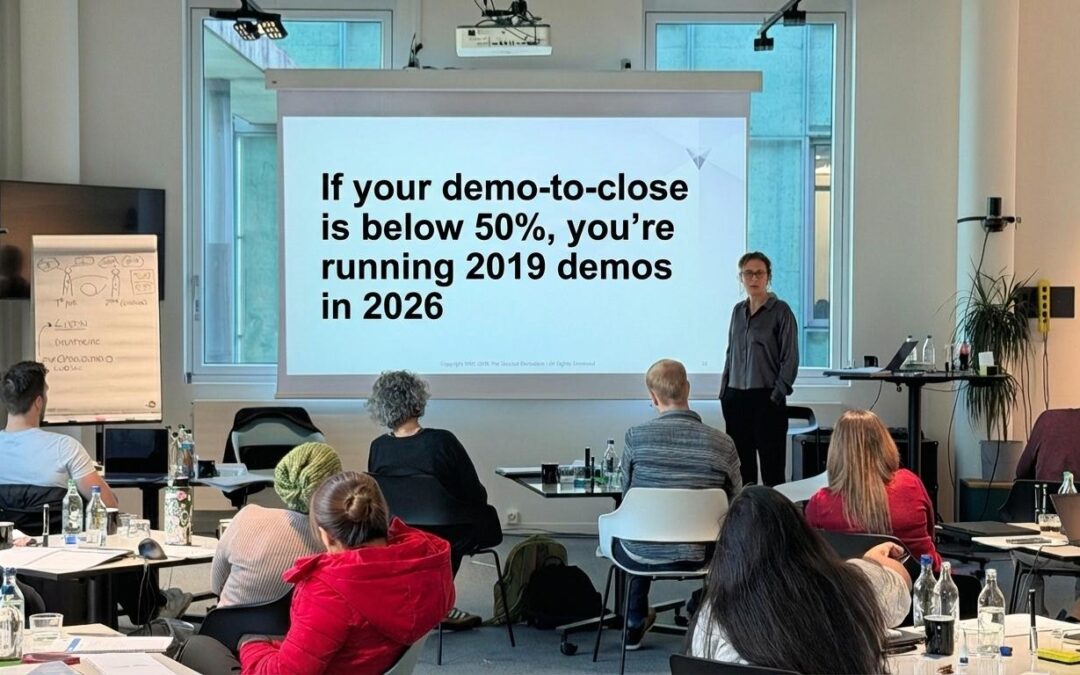
In 2026, B2B SaaS demos are no longer late-stage presentations meant to “show the product.” They have become decision moments, especially in the €200k–€2M range with long cycles, multiple stakeholders, and shared accountability.
Across Life Sciences, Enterprise SaaS, Cloud, Cybersecurity, and other complex B2B environments, I see the same pattern repeat. Teams keep running polished, 60-minute platform walkthroughs and are surprised when deals stall or quietly disappear.
After more than 20 years of training demo teams at over 200 companies, one thing is clear: the teams that close deals design demos around decisions. The teams that struggle to design demos around features.
Below are the shifts I see playing out now, and where demos most often fall apart without anyone noticing.
1. Demos are becoming decision moments, not presentations.
Buying committees now include 10 to 11 stakeholders, each responsible for a different decision. Teams running the same 60-minute walkthrough for everyone no longer close deals.
The strongest teams design demos around who decides what and when.
For instance, Enterprise SaaS deals die when teams demo CRM workflows to a CFO instead of showing the impact on subscription revenue forecasting upfront.
2. Buyers don’t struggle to understand software. They struggle to choose.
By the time buyers engage with sales, they already know what the product does. What they’re unsure about is whether it truly solves their problem and whether their organization can adopt it. At this stage, you’re helping the buyer frame a decision.
For instance, Life Sciences vendors don’t win by listing compliance features. They win by reframing it as “we cut your audit prep from six weeks to six days.” That’s something a CFO can take to the board.
3. Discovery moved inside the demo.
Buyers want to see the product before articulating their needs. The strongest teams use the demo itself to surface priorities, assumptions, and misalignment. Their questions are your discovery.
For instance, Analytics platforms close deals by analyzing the prospect’s actual data live, not sample datasets. What they ask tells you everything a qualification framework doesn’t.
4. You’ll rethink when to deploy your experts.
75% of buyers prefer to explore alone first. Your best SCs are doing 30 demos monthly to close 3 deals. Let automation qualify them. Deploy experts only for €200k–€2M opportunities with multiple stakeholders and year-long cycles.
For instance, Cloud infrastructure vendors use demo automation upfront. Solutions Architects only engage when conversations need complex architecture decisions and compliance mapping.
5. Demos will get shorter and sharper
60-minute platform tours no longer reflect how people buy now. Each stakeholder expects to see their problem reflected quickly. Teams that tailor demos to the stakeholder and the decision moment close faster.
For instance, Cybersecurity vendors no longer walk buyers through platform modules. They open with the decision problem: “Your average breach detection time is 287 days. This brings it down to 48.” Everything else is secondary.
I’m seeing these shifts play out across teams now. Some are adjusting early. Most are still running the same demos and wondering why deals don’t convert.
Fix your B2B SaaS demos today. Get in touch!

Natasja Bax
Founder of The DemoScene
President of Great Demo! EMEA
Recent Posts
How to Structure a Compelling Sales Demo
Comparing ‘Great Demo!’ and ‘Demo2Win’ for Impactful Sales Demos
7 Proven Strategies for Automated Demos to Boost Conversions
Avoid ‘Death by Corporate Overview’ in Sales Demos
Customer Success Needs Better Discovery and Demo Skills
 Natasja Bax Owner
Leveraging years of experience in presales and training/coaching, Natasja directly pinpoints the areas in need of improvement and maximizes the performance of individuals and teams in an energetic and uplifting manner. Her feedback is personal, honest, and always focused on the best results.
Natasja Bax Owner
Leveraging years of experience in presales and training/coaching, Natasja directly pinpoints the areas in need of improvement and maximizes the performance of individuals and teams in an energetic and uplifting manner. Her feedback is personal, honest, and always focused on the best results.